

Relationships are meant to bloom when both partners put in a joint effort. However, sometimes the balance tips, and you find yourself doing most of the work.
That’s when you know you’re on the lower end of the spectrum in terms of effort. And without a doubt, one-sided relationships can be emotionally draining and mentally exhausting. So, what are the signs of an unequal relationship?
Signs of a one sided relationship often include poor communication, where your partner isn’t interested in listening or sharing their thoughts and feelings with you.
You may also find yourself apologizing more than necessary, constantly trying to keep the peace. If you’re prioritizing them more than they prioritize you, that’s another indication of an imbalanced relationship.
You may also make excuses for their shortcomings and feel generally burnt out.
In the long run, being the one who does all the heavy lifting can take a toll on you. That’s why it’s essential to recognize the signs of an unequal relationship and take action to either restore the balance or consider leaving before you find yourself in too deep.
Understanding the signs of a one sided relationship can help you navigate your way to healthier and happier connections in the future.
To understand selfish one sided relationships, we need to know what one sided relationships are, learn how people end up in them and if there’s a future for them.
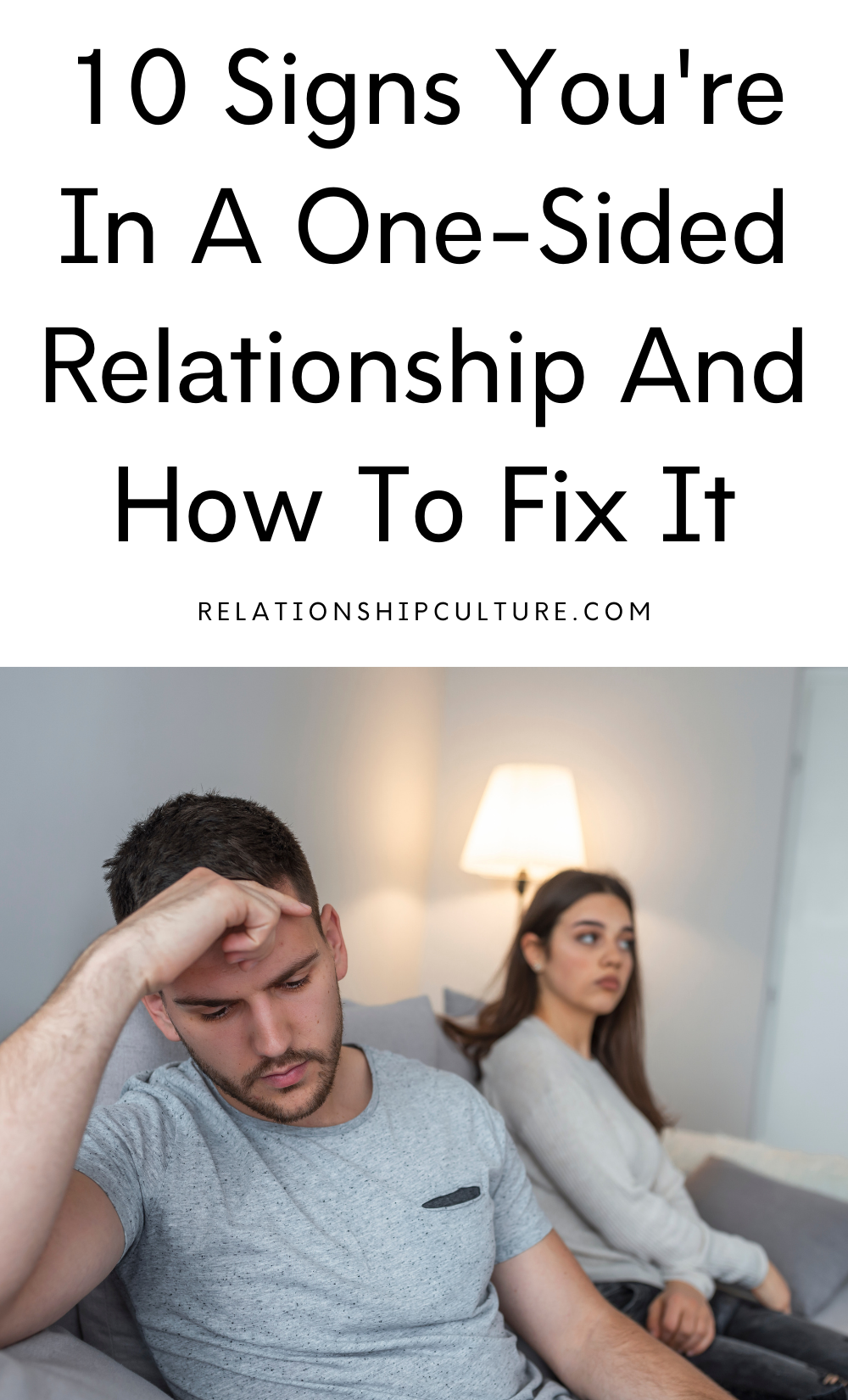
What Is A One Sided Relationship?
In a one-sided relationship, there is an imbalance in the effort, commitment, or emotional investment between the two individuals involved.
It often happens when one person constantly gives and puts in effort while the other takes without giving much in return.
Imagine a seesaw on a playground. In a healthy relationship, both people sit on the seesaw, taking turns pushing and pulling to keep it balanced and enjoyable for both sides.
But in a one-sided relationship, it’s like only one person is sitting on the seesaw, performing all the work, while the other person sits there, not contributing or reciprocating.
It can happen in various types of relationships, such as friendships, romantic relationships, or even family relationships.
For example, let’s say you have a friend who only calls you when they need something, but they are rarely there for you when you need support.
That’s a classic example of a one-sided friendship. Or in a romantic relationship, if one partner consistently ignores the other person’s needs, feelings, or opinions, it creates an unhealthy dynamic where one person carries most of the emotional load.
In a healthy and fulfilling relationship, there should be a mutual exchange of support, care, and effort. Both individuals should feel valued and respected, with each person contributing to the relationship’s growth and happiness. Communication, compromise, and empathy are vital ingredients for a balanced and fulfilling connection.
If you find yourself in a one-sided relationship, it’s essential to communicate your feelings and concerns with the other person. An honest conversation brings awareness to the issue and allows for positive changes.
However, if the one-sidedness persists despite your efforts, it might be worth considering whether the relationship is healthy and beneficial.
It’s important to nurture connections where the seesaw of effort and care is well-balanced.
How Do People End Up In One Sided Relationships?
One-sided relationships can occur when there is an imbalance in effort, commitment, or emotional investment between two people. These imbalances can arise due to various reasons.
Sometimes, people enter into relationships with different expectations or assumptions about how the relationship should function. They may have differing ideas about the level of support, attention, or effort that should be given.
This mismatch can lead to one person investing more in the relationship while the other person may not be aware or willing to meet those expectations.
Communication plays a crucial role in any healthy relationship. When there is a lack of open and honest communication, it becomes difficult for both individuals to understand each other’s needs, boundaries, and concerns.
Without effective communication, one person may unknowingly dominate the relationship while the other person feels neglected or unheard.
Low self-esteem can also contribute to one-sided relationships. People with low self-esteem may believe that any relationship, even an imbalanced one, is better than being alone.
They may struggle to assert their needs and boundaries, leading to a dynamic where one person takes advantage while the other person tolerates it.
Codependency is another factor that can contribute to one-sided relationships. In codependent relationships, one person becomes overly dependent on the other for self-worth and validation.
They may prioritize the needs of the other person and neglect their own. This can create a dynamic where one person consistently gives while the other person takes.
Sometimes, one person may manipulate or control the other to maintain power in the relationship. They may use tactics like guilt-tripping, emotional manipulation, or gaslighting to keep the other person subservient and prevent them from asserting their needs.
This manipulation can lead to a one-sided dynamic where one person holds all the power. Recognizing that individuals don’t actively seek out one-sided relationships is important.
These dynamics often develop gradually and can be challenging to identify until the imbalance becomes significant.
Individuals can work towards healthier and more balanced relationships by promoting open communication, setting and respecting boundaries, building self-esteem, and being aware of signs of manipulation.
Can The Tables Ever Turn?

Yes, it is possible for the tables to turn in a one-sided relationship. Still, it depends on the specific circumstances and the willingness of both individuals to address the imbalance. Here are a few scenarios where the tables could potentially turn:
I. Increased Awareness And Communication
If the person who has been more passive or neglectful in the relationship becomes aware of the imbalance and is open to change, they can actively work on improving their behavior.
By engaging in honest and open communication, they can understand the concerns of their partner and make efforts to address them.
II. Setting Boundaries And Asserting Needs
The person who has been giving more in the relationship can develop a deeper sense of self-worth and begin to set healthier boundaries.
They can assert themselves and create a more balanced dynamic by clearly expressing their needs, expectations, and limits. This can prompt the other person to reflect on their behavior and make changes.
III. Relationship Counselling Or Therapy
Seeking professional help can provide a supportive and neutral space for both individuals to explore the dynamics of their relationship.
A skilled therapist can assist in facilitating communication, helping both parties gain insight into their roles and responsibilities. Through therapy, individuals can work together to establish healthier patterns and address the one-sidedness.
IV. Mutual Growth And Commitment
Relationships evolve over time, and people can change. If both partners are committed to personal development and improving their connection, they can actively work towards a more balanced dynamic.
By continuously nurturing the relationship, addressing concerns, and finding ways to support each other, they can gradually shift from a one-sided dynamic to a healthier and more equitable relationship.
It’s important to note that turning the tables in a one-sided relationship requires effort, commitment, and willingness from both individuals.
If one person is resistant to change or unresponsive to improvement efforts, achieving a balanced relationship may be challenging.
In such cases, it’s crucial to reassess the health and viability of the relationship and consider whether it’s in the best interest of both parties to continue.
What Are The Signs Of A One Sided Relationship?
Recognizing the signs of a one-sided relationship is crucial for maintaining personal well-being and fostering healthier connections. So, let’s explore some common signs you’re in a one sided relationship.
Remember that these signs are not definitive proof but potential indicators that warrant reflection and further evaluation. So what does a one sided relationship look like? Signs you’re in a one sided relationship include:
1. You Put Them First
One of the signs of a one sided relationship is you always putting your partner first. In a one-sided relationship, you consistently prioritize your partner’s needs and desires above your own.
Your focus is primarily on catering to their wants and ensuring they’re happy, often at the expense of neglecting your well-being.
While it’s natural to make compromises and show consideration in a healthy relationship, it becomes problematic when it becomes a pattern of consistently prioritizing your partner while neglecting your own needs.
It can lead to resentment, imbalance, and a lack of personal fulfilment. In a healthy and balanced relationship, both people should have their needs acknowledged and respected.
Establishing open and honest communication about your desires, boundaries, and expectations is important. You can work towards a more balanced relationship by expressing your needs and finding ways to create a mutually beneficial dynamic.
2. They Show Little Interest In Future Plans
In a balanced relationship, both partners should be interested in and excited about future plans. They should be willing to engage in discussions about shared goals, aspirations, and dreams.
However, in a one-sided relationship, your partner may lack enthusiasm or engagement in these conversations, leaving you feeling like you’re the only one with a vision for the future.
For example, you’ve been dreaming about the future and making plans for exciting adventures together. But whenever you try to involve your partner in discussing future goals, they seem disinterested or uninvested.
It’s like you’re playing a solo game of envisioning the future while they’re on the sidelines, not actively participating. This is one of the signs of a one sided relationship to watch out for.
Being with someone who supports and shares your enthusiasm for building a future together is important. If you’re in a relationship and your partner shows little interest in future plans, it may be worth exploring the underlying reasons behind their disengagement.
Have open and honest conversations to understand their perspective and assess whether your long-term visions align.

3. Their Schedule Takes Priority
This is another one of the signs of a one sided relationship you should be mindful of. In a one-sided relationship, you may notice that your partner consistently prioritizes their schedule over yours.
It can feel like their commitments, plans, and activities always take precedence, while your own schedule and availability are often disregarded or treated as less important.
Your partner may not be considering your needs or trying to find a balance between their commitments and the time you spend together.
You might find yourself constantly adjusting your plans or rearranging your schedule to accommodate theirs while they are less willing to do the same for you.
If they have plans, you have to cancel yours. If they suddenly decide their family is coming over, you must cancel all your plans and stay over.
This type of relationship can create a sense of imbalance and unease because you feel like a secondary consideration in the relationship.
Feeling like your partner’s schedule always takes priority can be frustrating and contribute to resentment or dissatisfaction.
In a thriving relationship, both partners should be ready to compromise and find mutually beneficial solutions regarding planning and scheduling.
Don’t hesitate to assert your needs and advocate for a relationship where both partners make an effort to accommodate and prioritize each other’s schedules.
Your time and availability are valuable, and they deserve to be respected and given consideration.
4. Poor Communication

Communication is the secret sauce that makes relationships thrive. But one of the signs of a one sided relationship is poor communication. It’s as if the communication lines are full of static or on mute.
You might find yourself constantly initiating conversations, sharing your thoughts and feelings while your partner responds with minimal engagement or fails to reciprocate.
It’s like trying to have a deep conversation with a brick wall. Whenever you try to run ideas by them, they never have much to say or instantly agree with what you have to say.
It could also be that arguments have increased because they come to condemn your decisions long after they’ve been made.
In a healthy relationship, both partners should actively participate in communication, listen attentively, and express themselves openly and honestly. Relationships are two-way, so don’t be afraid to speak up and find that balance!
5. They Are Never Consistent
Consistency is vital in a healthy relationship. It’s like having a steady rhythm that keeps the connection strong. Both partners should consistently show up, be emotionally available, and invest in the relationship.
In a one-sided dynamic, the lack of consistency can leave you feeling confused and unsure of where you stand.
Imagine you’re on a roller coaster, and just when you start enjoying the ride, it suddenly comes to a screeching halt. In a one-sided relationship, you might experience a lack of consistency from your partner.
One moment, they’re showering you with attention, affection, and commitment, and the next moment, they disappear or become distant. It’s like riding a roller coaster with unexpected twists and turns, leaving you feeling uncertain and off balance.
Inconsistency leaves you on edge because you never know which side of your partner to expect each day.
You always pray for the good side; when the wrong side comes, you’re disappointed, which can affect your well-being. Having a consistent partner is critical to having a successful relationship.
Remember, you deserve a partner who consistently shows up, supports you, and maintains a reliable presence in your life. Don’t be afraid to seek that consistency and find a balanced and fulfilling relationship for both of you!
6. You’re Constantly Burnt Out

Another of the signs of a one sided relationship is that you’re constantly burnt out. You’re constantly burnt out and stressed because you give more than you get.
In a one-sided relationship, you might find yourself constantly giving and pouring your energy into the relationship but receiving little in return.
It’s like carrying the weight of the world on your shoulders while your partner enjoys a carefree existence. This is a clear sign of imbalance which can lead to emotional and physical burnout, leaving you exhausted and drained.
Having a partner who supports and uplifts you is crucial, not someone who adds to your already heavy workload.
7. They Never Appreciate You
Another one of the crucial signs of a one sided relationship to look out for is a lack of gratitude from your partner.
In a one-sided relationship, it can feel like your efforts, contributions, and presence go unnoticed and unappreciated by your partner.
It’s like being the unsung hero in a movie, where your actions and support are taken for granted, leaving you feeling undervalued and unacknowledged.
Appreciation is an important aspect of any healthy relationship. It’s a way to express gratitude, acknowledge each other’s efforts, and make the other person feel valued.
However, in a one-sided relationship, your partner may consistently fail to show appreciation for what you bring to the table.
Whether it’s the little things you do, the support you provide, or the love and care you give, feeling unappreciated can be disheartening and demoralising. It can erode your self-esteem and leave you questioning your worth within the relationship.
Your partner not appreciating you is also a sign they take you for granted. To them, it might mean you’re dispensable.
In one sided relationship psychology, your partner not appreciating you could mean a myriad of other things as well, none of which are good.
Remember, you deserve to be with someone who recognizes and appreciates your efforts, big or small. Don’t hesitate to voice your needs and advocate for a relationship where mutual appreciation is fostered and expressed.
8. You Apologize A Lot
Apologizing excessively can be one of the signs of a one sided relationship. It could be that you’re shouldering the burden of the relationship’s problems, even when it’s a shared responsibility.
You might find yourself constantly taking the blame and apologising for things that aren’t entirely your fault. It’s like doing a dance routine where you always say sorry, even when it’s unnecessary.
You apologize for everything because you want to preserve the relationship.
However, your partner fails to apologize for their wrongdoings because they don’t want to maintain the relationship. They might be okay with the relationship ending and use this bad behavior to foster the separation.
Having a partner who acknowledges their part in conflicts and takes responsibility when needed is important.
In a healthy relationship, both partners should communicate openly, take accountability for their actions, and work together to find resolutions. If you notice yourself constantly apologizing, it’s worth reflecting on the dynamics of your relationship.
It’s important to have fulfilling conversations with your partner, expressing your feelings and concerns. Remember, a balanced relationship requires mutual understanding, compromise, and the willingness to address issues.
9. You Make Excuses For Them

Another one of the signs of a one sided relationship is you might find yourself constantly making excuses or justifying your partner’s behavior.
It’s like being a professional spokesperson for their actions, always finding reasons to defend or explain away their shortcomings.
Peradventure, they do something you don’t like, and you make up an excuse for why they did it. “Oh, he was probably tired,” “Maybe she’s just having a bad day,” “Maybe he was stressed at work”.
Now it’s normal to have bad days from time to time because we are human, after all, but when such behaviour becomes constant, and your partner starts to lose regard for you, it’s time to start asking, “Am I in a one sided relationship?”.
Making excuses can be a coping mechanism to protect yourself from acknowledging the imbalance or addressing deeper issues within the relationship.
However, it’s important to recognize that healthy relationships require open communication and accountability from both partners.
10. You’re Not Happy
One of the signs of a one sided relationship is a lack of happiness. Happiness is like a vibrant rainbow that should grace the sky of your relationship.
However, that rainbow might feel more like a fleeting mirage in a one-sided relationship. If you consistently feel unhappy, unfulfilled, or emotionally drained in your relationship. You’re unhappy because the relationship is not fulfilling; whatever is unfulfilling will be emotionally draining.
You’ll find yourself sitting on the fence depending on your partner’s mood for bits of happiness. And such happiness is fleeting because, in a one sided relationship, your partner’s good mood too is fleeting.
Your emotional well-being should be prioritized, and a healthy partnership should contribute positively to your happiness and contentment.
Suppose you consistently find yourself making excuses for your partner and feeling unhappy. In that case, it may be time to reassess the relationship dynamics and consider if it’s genuinely serving your well-being.
Remember, you should be in a relationship where your happiness is valued and where open and honest communication is fostered. Don’t settle for the bare minimum, and be open to exploring healthier and more fulfilling connections.
We’ve gone over 10 signs of a one sided relationship and how it can affect you. Awareness of the signs of a one-sided relationship is essential for maintaining your well-being and fostering healthier connections.
These signs include putting your partner first, always initiating plans, their schedule taking priority, poor communication, lack of consistency, feeling constantly burnt out, lack of appreciation, excessive apologizing, making excuses for your partner, and overall unhappiness.
Recognizing these signs allows you to reflect on the dynamics of your relationship and assess whether it is truly fulfilling and balanced.
Remember, a healthy relationship should be a two-way street where both partners contribute, communicate, and support each other.
Healthy relationships thrive on mutual respect, understanding, and compromise. Don’t be afraid to prioritise your well-being and seek a relationship that brings you joy, fulfilment, and mutual growth.
Ultimately, by being aware of these signs and taking action, you can strive for a healthier and more fulfilling relationship that allows you and your partner to thrive and experience the love and support you deserve.
Save this for later!
